Neighbourhoods
Belem is a monument district, not a neighbourhood
It reads as a place to live on a map and behaves like an open-air exhibition on the ground. Knowing which one you are visiting changes how you plan the day.

The points below about monument districts are ordered by how much difference they make, not by how often they get repeated.
What matters most
- Almost everything visitors come for sits on one riverside axis.
- The monuments are there because this is where the river meets the sea.
- The residential part is uphill and behind, and few visitors reach it.
Everything is on one line
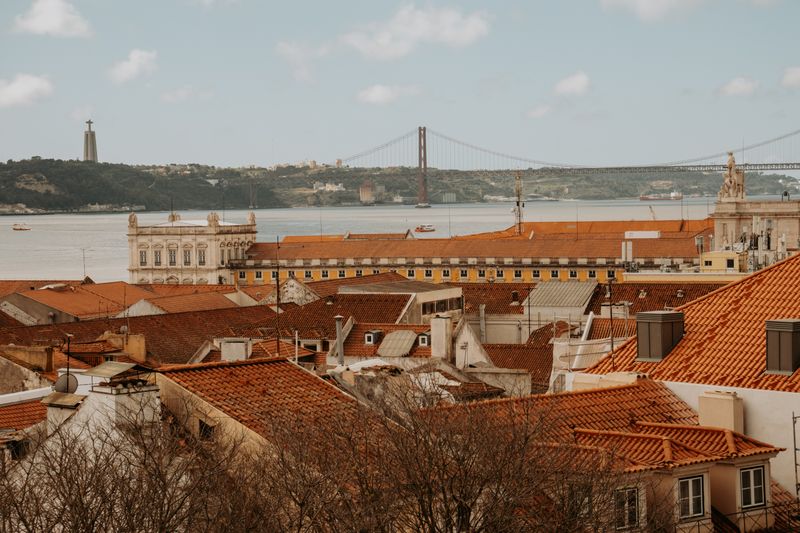
The sights are strung along a narrow riverside strip, which means the district is walked as a line rather than explored as an area. That single axis concentrates every visitor into the same few hundred metres, and the crowding you feel is a consequence of the geometry rather than the numbers.
Step two streets inland and the density collapses immediately, which is the simplest crowd-avoidance move available anywhere in the city. Because it is a line, backtracking is expensive in time, so the order you visit things in matters more here than in a compact old quarter. The flat riverside path makes the whole strip unusually accessible by the standards of a city built on hills, which is part of its appeal.
Why the monuments are here
This stretch of bank sits where the river widens towards the ocean, and it was the practical point of departure for voyages leaving the country. Building religious and ceremonial architecture at the point of departure and return was a deliberate act, tying the voyages to state and church at once. Later monuments were added to the same strip precisely because the earlier ones were there, which is how commemorative districts accumulate everywhere.
Put simply, the result is a concentration of ceremonial building unlike anywhere else in the city, and a district whose purpose was always partly symbolic. Understanding that the strip is about departure explains why it faces the water and turns its back on the town behind it.
The distances deceive
On a map the monuments look adjacent, and on foot the gaps between them are long, exposed and almost entirely without shade. A wide road and a rail line separate parts of the strip from the water, so crossings are limited and detours are common.
In practice, in midsummer that combination of distance, glare and reflected heat off stone and water is genuinely tiring by early afternoon. The practical fix is to treat the strip as two or three short outings rather than one continuous march from end to end. Arriving early or staying late shifts both the light and the crowd, and the two problems happen to have the same solution.
The district behind
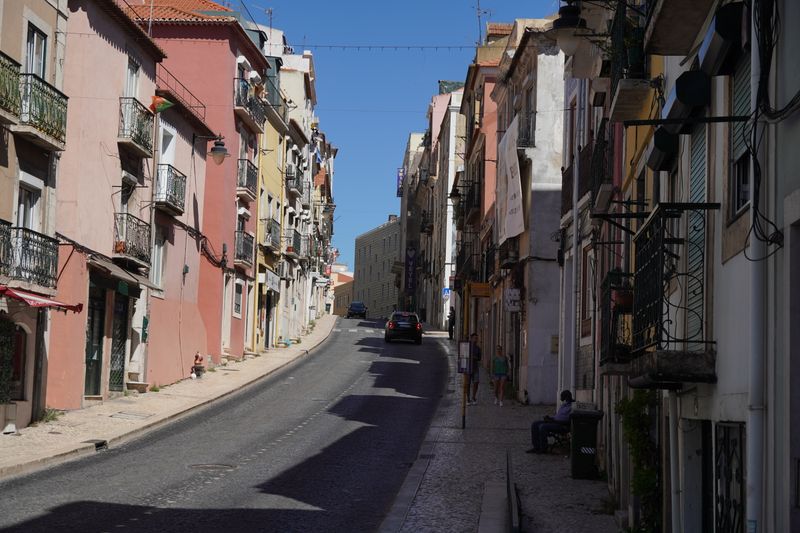
Uphill and inland there is an ordinary residential quarter with schools, a market, everyday shops and none of the exhibition atmosphere. It climbs steeply, which is why almost nobody on the riverside strip ever sees it despite it being a few minutes away.
The contrast is instructive: one part of the district is organised entirely around visitors and the other is organised around a normal week. Prices for food and coffee change noticeably across that boundary, for the ordinary reason that the customer base changes with them. If you want to understand how a monument district relates to the city that hosts it, the walk uphill is the interesting part.
Queues are a design problem
When a handful of doorways admit everyone who comes to a district, queueing is structural rather than a sign that you arrived at the wrong moment. Sites with several entrances and generous internal circulation absorb the same number of people with far less visible waiting. The buildings here were designed for processions and congregations, not for a continuous flow of ticketed visitors, so the bottlenecks are architectural.
Put simply, that means the usual advice about timing only partly works, because the constraint is the door rather than the hour. Booking ahead where it is offered, and accepting that some interiors are better skipped on a busy day, is the realistic response.
Adjust the size of it until it is something you would actually do tired.
Using a half day well
Pick two interiors rather than five, and spend the rest of the time outside, where the district is genuinely at its best. The riverside walk itself is the underrated part, because the width of the water here is unlike anywhere further upstream.
Where it helps most, pastry is inseparable from the district in the public imagination, and the queues reflect that, but equivalent quality exists in every quarter of the city. Late afternoon light on pale stone is the reason photographers come, and it also happens to be when the coach traffic thins. Treating it as one focused half day, rather than a whole day of forced marching, is the difference between enjoying it and enduring it.
Everything above, in order of what to do first
- Everything is on one line. The sights are strung along a narrow riverside strip, which means the district is walked as a line rather than explored as an area.
- Why the monuments are here. This stretch of bank sits where the river widens towards the ocean, and it was the practical point of departure for voyages leaving the country.
- The distances deceive. On a map the monuments look adjacent, and on foot the gaps between them are long, exposed and almost entirely without shade.
- The district behind. Uphill and inland there is an ordinary residential quarter with schools, a market, everyday shops and none of the exhibition atmosphere.
- Queues are a design problem. When a handful of doorways admit everyone who comes to a district, queueing is structural rather than a sign that you arrived at the wrong moment.
- Using a half day well. Pick two interiors rather than five, and spend the rest of the time outside, where the district is genuinely at its best.
The takeaway
One line along the water, one town behind it. Most visitors only ever see the line.
Pick the one that costs you least, and let the rest wait.
Questions readers ask
Can you do it in half a day?
Comfortably, if you choose two interiors and walk the rest. Trying to see everything in one visit is what makes people miserable.
Is it worth walking inland?
If you want to see how the district actually lives, yes. It is steep, quiet, ordinary and about five minutes from the crowds.
Also by Inês Carvalho
- How to order coffee in Lisbon without overthinking itCafés & Coffee
- The hills are the transport systemPracticalities
- Sintra in a day, done properlyDay Trips
- What catches visitors outPracticalities