Neighbourhoods
Tiles are cladding, not decoration
The glazed façades that everyone photographs are doing structural and climatic work, and they are disappearing for specific reasons.

This looks at tiled facades from the practical end — what holds up once conditions stop being ideal.
What holds up in practice
- A glazed surface sheds Atlantic rain that would soak render.
- Tiles bounce light into narrow streets that would otherwise be dark.
- Theft and unsympathetic replacement are both real threats to surviving façades.
A wall that sheds water
Lisbon takes heavy, wind-driven rain off the Atlantic through the winter, and a rendered wall absorbs it. A glazed ceramic skin sheds that water almost entirely and dries fast in the wind afterwards.
Tiled buildings therefore stay drier inside, which matters in a city where damp is the standard winter complaint. The decorative element grew on top of a practical solution rather than the other way round.
Light in a narrow street
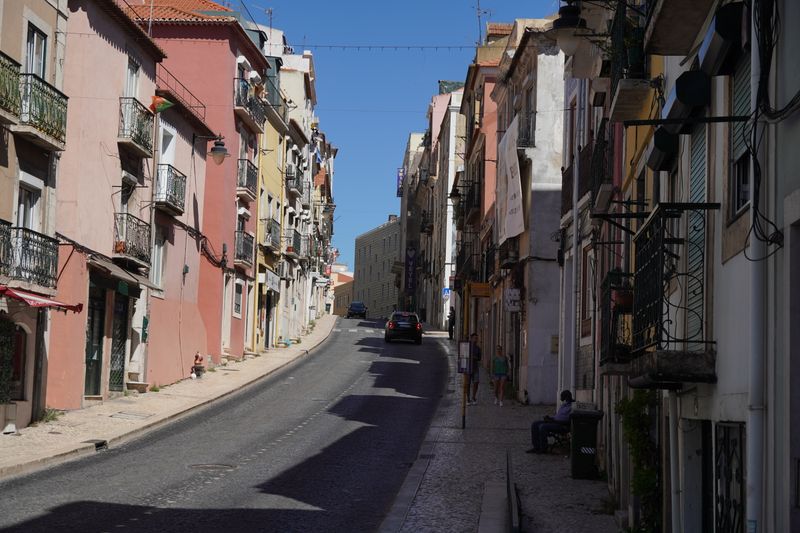
Old streets are narrow relative to building height, so ground floors get very little direct sun. Glossy tiles reflect and scatter what light there is, which measurably brightens a lane.
On an ordinary week, pale and blue-white glazes do this more effectively than dark ones, which is part of why they dominate. On a grey day the difference between a tiled street and a rendered one is obvious from the pavement.
Heat and the summer wall
A ceramic skin over masonry adds a small air and material layer between the sun and the interior. Its reflectivity reduces absorbed heat compared with a dark rendered surface. It is not insulation in any modern sense, and tiled buildings still get hot in August.
Traditional deep window reveals and shutters do far more of the thermal work than the tiles do.
Reading a façade
Repeating small-pattern tiles applied across a whole elevation are typically nineteenth-century industrial production. Hand-painted panels telling a scene are usually older, rarer, and were expensive when new. Modern reproductions tend to have a flatter glaze, a more uniform edge and grout lines that look too regular.
A patch of new tile in an old field is easy to spot once you have noticed the difference in surface reflection.
Why panels go missing
Antique tiles have resale value, and theft from vacant or derelict buildings has been a persistent problem. Protective rules exist in the city and enforcement is uneven, particularly on privately owned buildings mid-renovation.
Once a run of tile is broken, matching the glaze and the size is difficult and expensive, so owners often render over the lot. That is how a tiled street quietly becomes a painted one over a couple of decades.
Looking without collecting
Loose tiles on a derelict façade are not souvenirs, and taking them is theft from a listed fabric. Workshops and markets sell reproductions and genuinely surplus salvage, which is the honest way to take one home.
Photographing them is free and, unlike prising one off, leaves the wall intact. The best examples are usually on ordinary residential streets rather than on the routes with the crowds.
How they fail, and how you can hear it
Tiles are bedded into lime mortar rather than glued on, and failure nearly always begins behind the glaze when water gets in from a cracked cornice or a leaking gutter somewhere above. Once the bed is wet the tile loses its grip and rings hollow when tapped, which is how a surveyor finds the loose areas long before anything actually falls into the street. Salt drawn up through old masonry crystallises behind the ceramic and pushes it off the wall, which is why decay is often worst along the bottom of a façade rather than at the top.
The only repair that lasts is fixing the water coming in above, since re-bedding tiles onto a wall that is still getting wet buys a couple of winters at most.
The takeaway
The tiles are a raincoat and a lamp. The pattern is the last thing they do.
Small and repeatable beats ambitious and abandoned, almost every time.
Questions readers ask
Why are so many buildings half-tiled?
Usually because a renovation, a repair or a theft removed part of the original run and matching it was too difficult or too costly.
Can I buy old tiles legally?
Salvage dealers and markets sell tiles from demolished buildings, and reproductions are widely available. Provenance varies, so ask.
Also by Duarte Ferreira
- Viewpoints without the queueNeighbourhoods
- The staircase streets and how they organise a hillNeighbourhoods
- Two microclimates: the riverside and the ridgeNeighbourhoods
- What happens in a square, and whenNeighbourhoods