Neighbourhoods
Why The Embassies Cluster On One Hill
Diplomatic missions concentrate in a few western districts because large detached houses with gardens and defensible frontages exist there and almost nowhere else in the city.
Embassies and residences cluster in a small number of western districts rather than spreading across the city. The reason is the building stock, and it explains how those streets feel.
A mission needs a building type that is rare here
A diplomatic mission wants a large detached or semi-detached building with its own entrance, some ground around it and a frontage that can be controlled.
Most of the city is dense terraced apartment building with shared entrances and no setback, which suits none of those requirements.
The districts where large houses with gardens were built for wealthy families in the eighteenth and nineteenth centuries are therefore the only realistic supply.
Those houses exist because the rich moved west
After the earthquake and through the following century, wealthier households moved to higher ground west of the centre, away from the crowded riverside.
They built palacetes: substantial houses on their own plots, with gardens, coach access and outbuildings, on streets laid out at a generous width.
When those families later could not maintain such houses, institutions took them, and embassies were among the few tenants who wanted exactly that form.
Clustering then becomes self-reinforcing
Once several missions are in one district, the area accumulates the services that support them: consular queues, translation offices, notaries and specialist schools.
Security arrangements also work better in a cluster, since policing and traffic management can cover several sites in one operation.
New missions arriving therefore look in the same streets, which keeps the concentration stable across decades even as individual buildings change hands.
What it does to the street
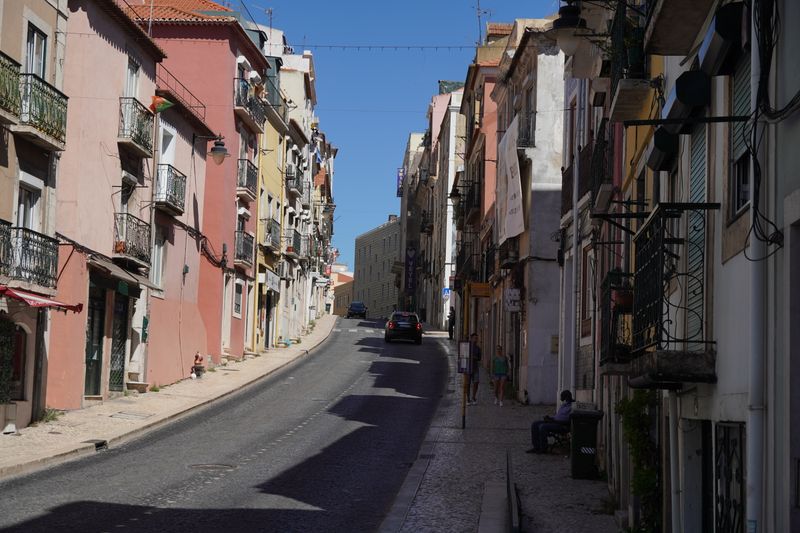
These are quiet streets with long stretches of blank wall, controlled gates and few ground-floor shops, because the buildings do not open onto the pavement.
Foot traffic is low and largely purposeful, which makes the districts feel calm and slightly empty compared with neighbourhoods of the same density elsewhere.
Cafés survive there by serving staff at fixed hours rather than passing trade, which is why they can be busy at eleven and dead at three.
The gardens are the hidden part
Much of the land in these districts is private garden behind walls, invisible from the street but substantial in area and full of mature trees.
That greenery moderates the temperature noticeably, which is part of why the western hills were desirable in the first place.
Occasionally one of these gardens opens to the public, and walking into one is the clearest way to understand what the whole district is built on.
Questions readers ask
Which neighbourhood should I stay in?
For a first short visit, somewhere central and flat is easiest. For a longer stay, one stop out is usually quieter, cheaper and more interesting.
Is the old town safe at night?
Generally yes, with ordinary caution. Pickpocketing in crowds is the realistic risk rather than anything more serious.
Also by Helena Sá
- Roast level is a decision about acidity, not about strengthCafés & Coffee
- Why the same beans taste different in two cafesCafés & Coffee
- Portuguese espresso is not a smaller Italian oneCafés & Coffee
- Grind is the dial that moves everything elseCafés & Coffee