Neighbourhoods
Ajuda And What Happens Around A Palace
A district built to serve a royal residence keeps the shape that job gave it, with oversized institutional buildings, service streets and a population that once worked uphill.

Districts that grew around a palace are organised differently from districts that grew around a market or a port. The evidence is in the street plan and the building sizes.
The palace came after the earthquake, and that decided the site
The court moved to high ground west of the centre following the earthquake, on the reasoning that a hill was safer and more open than the ruined riverside.
An enormous new residence was begun there, and although it was never finished as designed, the intention shaped everything built around it.
A partially completed palace still generates a full district, because the staff, suppliers and institutions arrive whether or not the building is finished.
Service population builds the housing
A royal household required an extensive workforce: kitchens, stables, gardens, laundries, guards, craftsmen and clerks, all of whom had to live nearby.
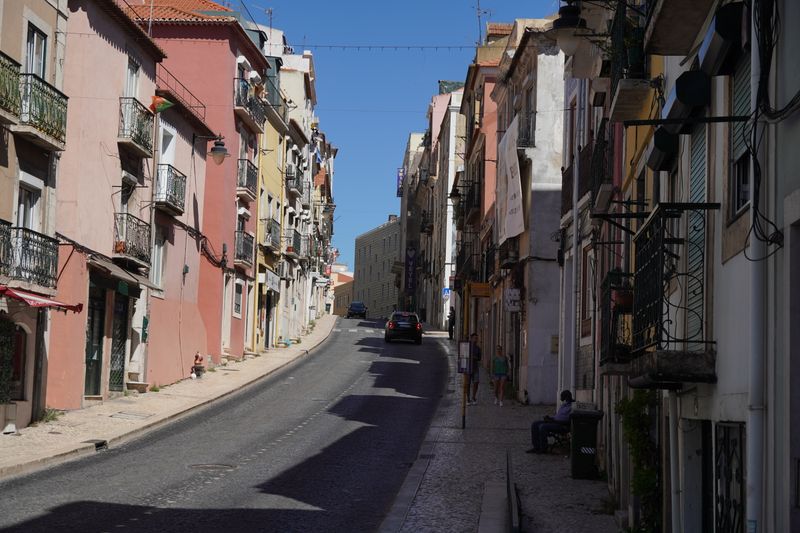
That produced modest housing on the slopes below and behind the site, laid out quickly and densely, on a very different scale from the palace itself.
The contrast between a monumental frontage and small workers' streets a few minutes away is the defining visual fact of such districts.
Institutions filled the gap afterwards
When the court ended, the large buildings needed new uses, and the ones that fit were institutional: schools, faculties, archives, botanical collections and museums.
Those uses suit the buildings because they need volume rather than commercial frontage, and because public ownership had already passed to the state.
The result is a district with an unusually high concentration of institutions relative to shops, which keeps the daytime and evening populations very different.
The botanical and garden legacy
Royal and institutional sites came with gardens established for display, study or supply, and several of these survive as formal public gardens today.
They are frequently terraced, because the ground falls steeply towards the river, and the terracing is itself a piece of eighteenth-century engineering.
These gardens are also the reason the district holds mature trees at a density the denser parts of the city cannot match.
How the district reads now
It is residential, quieter than the centre, and slightly detached from it, with a life organised around local streets rather than around visitors.
The steepness matters daily. Movement between the upper institutional level and the lower riverside is a real climb, and the two levels function almost separately.
Which is why a visit works best as a single level at a time rather than as a loop that keeps crossing the slope.
Questions readers ask
Which neighbourhood should I stay in?
For a first short visit, somewhere central and flat is easiest. For a longer stay, one stop out is usually quieter, cheaper and more interesting.
Is the old town safe at night?
Generally yes, with ordinary caution. Pickpocketing in crowds is the realistic risk rather than anything more serious.
Also by Helena Sá
- Roast level is a decision about acidity, not about strengthCafés & Coffee
- Why the same beans taste different in two cafesCafés & Coffee
- Portuguese espresso is not a smaller Italian oneCafés & Coffee
- Grind is the dial that moves everything elseCafés & Coffee