Eating
Why The Rice Dishes Arrive Wet
Portuguese rice dishes are deliberately soupy rather than dry, because the rice is cooked in a flavoured liquid that stays on the plate as part of the dish.

A rice dish here often arrives loose and wet, served in a pot with a spoon. That is the intended result, not an accident of timing, and it follows from how the dish is built.
The liquid is the flavour carrier
These dishes start with a stock made from the shells, bones or trimmings of whatever the dish is named after, and that stock does most of the work.
Cooking rice in it transfers flavour into the grain, but a large amount stays in the liquid, and discarding that liquid would discard the dish.
So the rice is cooked to a point where plenty of stock remains, and the whole thing is served together in the vessel it cooked in.
It is a different technique from a dry rice
A dry rice preparation aims for separate grains and an absorbed, evaporated liquid, and it is finished by resting off the heat.
A wet rice is nearer to a stew thickened by starch. Stirring during cooking is welcome rather than avoided, because released starch is what gives the body.
Both exist in Portuguese cooking, and the menu usually distinguishes them, but the wet version is the one that surprises people.
Timing decides everything
Because the rice keeps absorbing liquid after it leaves the heat, the dish is finished slightly loose so it arrives at the table correct.
That is why it cannot be held. A wet rice sitting for twenty minutes becomes a dry one, and kitchens will not prepare it in advance.
It also explains the wait. These dishes are cooked to order from a stock made earlier, and the cooking itself takes real time.
Portion sizes are built for sharing
Wet rice dishes are usually made for two or more and priced per person, arriving in one pot for the table rather than plated individually.
A single portion is possible in some rooms but is not the default, because a small quantity cooks differently and loses the character.
The pot arriving with a serving spoon is the signal. Everyone helps themselves and the dish continues to thicken slightly through the meal.
Seafood dominates but is not the only version
Shellfish and fish versions are the best known, since the shells give a strong stock, but the same method is applied to poultry, game, duck and vegetables.
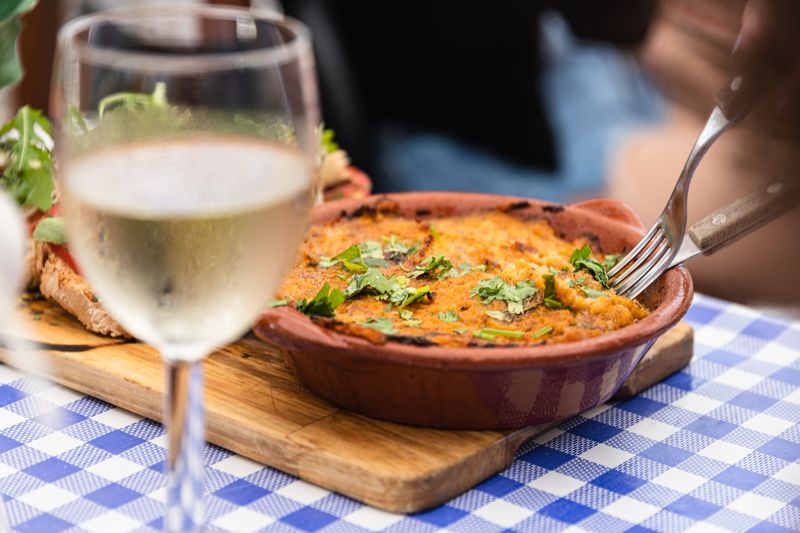
Some versions are then finished in the oven, which crisps the top while the base stays wet, giving two textures from one preparation.
Reading the name tells you the stock and therefore what the dish will taste of, which is usually more informative than the description beside it.
Questions readers ask
Why does the bread go hard so fast?
It has almost no fat, sugar or preservative, so the starch retrogrades quickly. The trade-off is a much better loaf on the day it was baked.
Is sourdough common?
Long-fermented artisan bread has grown in the city over the last decade and is easy to find, though it sits alongside rather than replacing the traditional daily roll.