Eating
How to read a pastry counter
The glass case follows a logic, and knowing it turns a wall of unfamiliar shapes into a set of decisions.
There is a settled way of talking about the pastry counter. It is worth asking how much of it survives contact with the detail.
The argument in brief
- Sweet and savoury usually occupy separate zones of the same case.
- Turnover matters more than appearance for freshness.
- Batches arrive at predictable points in the morning and afternoon.
The case has zones
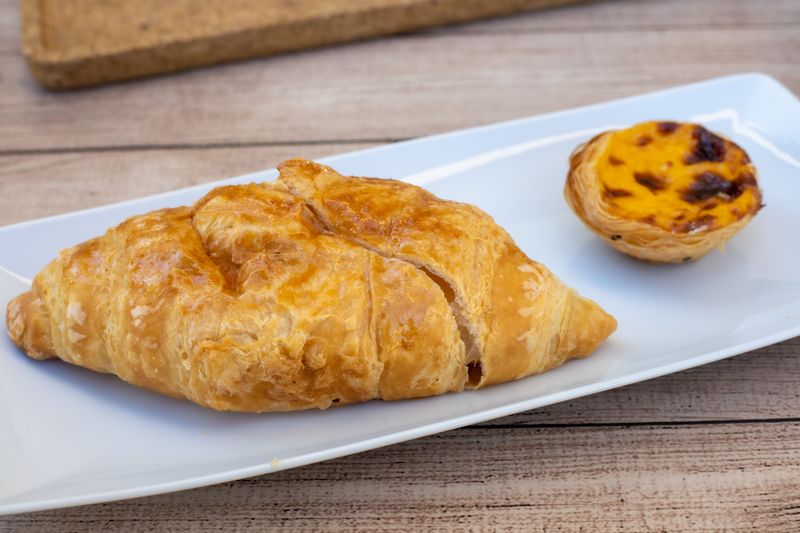
Most counters separate the egg-and-sugar pastries, the cream-filled items, the dry cakes and the savoury snacks into distinct areas. Custard-based things sit where they can be watched, because they are the fastest sellers and the most perishable.
Dry cakes and biscuits sit further from the till because they keep and need no attention. Once you see the zoning, an unfamiliar counter becomes navigable in about ten seconds.
Turnover beats appearance
A slightly untidy tray that is half empty at eleven in the morning is a better bet than a perfect full one. Items that sell slowly can sit for a long time and still look immaculate under glass. Watching what the people ahead of you order is the fastest reliable signal in any counter.
A queue of people who clearly work nearby is worth more than any review.
Batches and timing
Ovens generally run early for the morning trade and again in the afternoon before the after-work wave. The window shortly after a batch lands is when custard pastries are at their best, still warm and with the pastry crisp. By late afternoon the case may hold the remains of the day, which is fine for dry cakes and less so for cream.
Asking whether something has just come out is an ordinary question and usually gets an honest answer.
Custard, cream and egg
A great deal of Portuguese pastry is built on egg yolks and sugar, a tradition with roots in convent kitchens that used whites for other purposes. That gives a family of intensely sweet, rich, yolk-heavy sweets that can surprise people expecting something lighter. They are designed to be eaten in small quantities with bitter coffee, which balances them.
Eating one on its own with water is a much less flattering way to meet them.
The savoury half
Fried and baked savoury snacks — croquettes, filled pastries, small pies — occupy the other end of the case. They are cheap, filling and are the standard mid-morning or late-afternoon stopgap rather than a meal.
On an ordinary week, fried items are best soon after frying and are noticeably worse after sitting under a lamp. A counter with a hot cabinet turning over quickly is the one to use for these.
Ordering without the vocabulary
Pointing is entirely acceptable and universally understood in a pastry counter. Names vary between regions and even between shops, so nobody expects you to know them all. Ordering one item and a coffee, standing, and then ordering a second is normal behaviour rather than indecision.
For most people, prices are usually posted, and a coffee and a pastry remains one of the cheapest good things in the city.
The takeaway
Buy from the tray that is emptying, ask what just came out, and take a bitter coffee with it.
Pick the one that costs you least, and let the rest wait.
Questions readers ask
Is everything very sweet?
Much of the traditional repertoire is, because it is built on egg yolks and sugar syrup. The savoury half of the counter and the plainer breads are the counterweight.
Can I get pastry in the evening?
Counters generally thin out through the afternoon. What is left is fine but is not what the shop is proudest of.