Eating
Why the custard tart is a coffee accessory
The famous pastry is engineered around contrast, and eating it wrong is the most common way to be underwhelmed.
There is a settled way of talking about the custard tart. It is worth asking how much of it survives contact with the detail.
The argument in brief
- The tart is laminated pastry with a set custard, blistered at very high heat.
- It is meant warm, with something bitter alongside.
- Cinnamon and icing sugar are added by the eater, not the baker.
What is actually in it
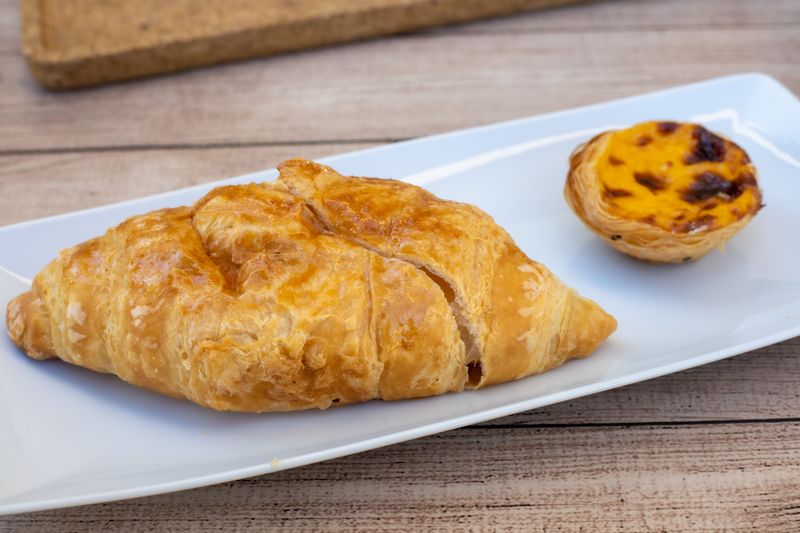
A laminated dough is rolled, coiled and pressed into a tin so it bakes into brittle spiralled layers rather than a short crust. The filling is a simple egg-yolk custard set with sugar syrup and a little flour.
It goes into a very hot oven, which blisters the top before the custard sets solid. The scorched spots are deliberate caramelisation, not a mistake, and a pale tart has been underbaked.
The contrast is the point
Everything about it is a pairing of opposites: crisp against soft, scorched bitterness against sweetness, hot against the cool of the custard beneath. That structure collapses as it cools, because moisture from the custard migrates into the pastry.
A tart that has sat for hours is a soft, uniformly sweet object rather than a contrast. This is why people who eat one from a supermarket shelf wonder what the fuss is.
Why it needs bitter coffee
The filling is very sweet, and sweetness is perceived less intensely against bitterness. A small dark espresso resets the palate between bites in a way a milky drink does not.
The traditional pairing exists because it works, not because of custom alone. Sugar in the coffee reduces that contrast, which is a reasonable trade if you dislike bitterness.
Cinnamon and sugar
Shakers of cinnamon and icing sugar are usually on the counter for you to add. Cinnamon adds an aromatic warmth that reads as less sweet even though nothing has changed in the sugar. Icing sugar mostly adds texture and appearance and is easy to overdo.
Whether to use either is a personal choice and there is no correct answer being enforced anywhere.
Quality varies enormously
The variables are the lamination, the oven temperature, the custard ratio and how recently it was baked. A neighbourhood pastelaria baking through the day frequently beats a famous counter selling to a queue. The tell is the pastry: it should shatter audibly and shed flakes rather than bend.
Price is a poor guide, and the queue outside is a worse one.
Beyond the one everyone knows
The same egg-yolk-and-sugar tradition produces a large family of other sweets, many of them regional and much less exported. Several are baked in the same ovens and sit in the same case at a similar price.
Trying one unfamiliar thing per counter is a cheap way to find out what else the tradition does. Some of them are considerably more interesting than the tart everyone photographs.
Adjust the size of it until it is something you would actually do tired.
Why it exists at all
The recipe descends from a convent tradition of egg-yolk sweets, which arose because religious houses used large quantities of egg white for starching cloth and clarifying wine and were left with mountains of yolk to use up. That surplus is why an entire national family of sweets is built on yolks, sugar and very little else, and why they are so much richer than the pastry traditions of places with no such by-product to absorb. When the religious houses were dissolved in the nineteenth century the recipes moved out into commercial bakeries, which is how a cloistered sweet became a counter item sold by the thousand.
The frozen industrial version now reheated in cabinets all over the world descends from that same move, and it is the reason so many people first meet the tart in the worst possible state.
The takeaway
Warm, crisp, blistered on top, with something bitter next to it. Any other version is a different pastry.
Pick the one that costs you least, and let the rest wait.
Questions readers ask
Should I ask for it warmed?
Many places will do it and some will not, because reheating cannot restore lamination once the pastry has gone soft. Buying from a fresh batch is better than warming an old one.
Is the cinnamon traditional?
It is a long-standing option offered at the counter rather than a fixed part of the recipe. Plenty of people take it without.