Cafés & Coffee
Where The City's Coffee Actually Came From
Portugal drinks a dark blend for historical reasons: coffee arrived through Brazil and later through African territories, and the roast style was built around what the ships brought.

The cup served in a Portuguese café tastes the way it does because of where the beans historically arrived from. The trade routes shaped the blend long before anyone described it as a national style.
Brazil made coffee an ordinary drink here
Coffee reached Portugal in volume through Brazil, which became an enormous producer while the two territories were joined. Supply was abundant, cheap and shipped to a home market that already had the habit.
Abundance is what turns a luxury into a routine. A drink that arrives in quantity at a low landed cost becomes something a working household buys weekly rather than something reserved for guests.
That early availability set the baseline expectation that coffee is cheap, which the modern café still works within even though the supply chain has changed entirely.
The African territories changed the bean itself
Later, substantial volumes came from African territories under Portuguese administration, and much of that crop was robusta rather than arabica. It entered the domestic blend as a matter of what was available.
Robusta carries more body, a heavier bitterness and a thicker crema under pressure. Blended in, it makes an espresso that reads as strong and full rather than bright.
Once a population is used to that profile, it becomes the reference point. Later imports were selected and roasted to match the taste that the existing supply had already created.
Dark roasting solved a supply problem first
A darker roast evens out variability between lots. When a roaster is blending several origins of uneven quality, taking the roast further makes the result consistent from sack to sack.
Consistency matters more than distinctiveness to a café selling the same cup every morning to the same people. A regular notices a change far more readily than a novelty.
So the dark blend was a practical answer that hardened into a preference. What began as a way to manage supply is now what the customer expects to taste.
The trade left buildings as well as habits
Coffee arriving by ship meant warehousing, roasting and distribution near the river, and several of the city's long-established coffee houses were founded in that commercial world.
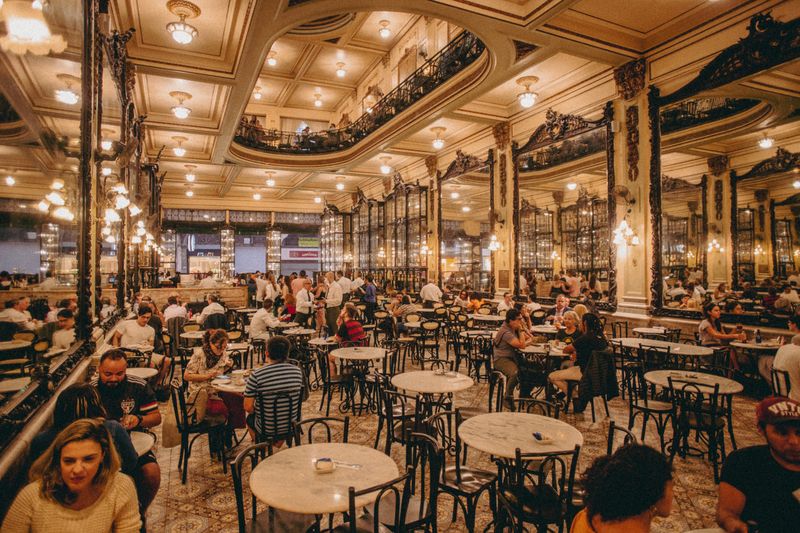
Some of the older grand cafés were built by importers or by people whose money came from the colonial trade, which is why they sit in the commercial districts rather than in residential ones.
The geography of the old coffee business is still legible in where those rooms stand, even where the firms behind them have long since gone.
What the history does not explain
It does not explain the current sourcing. Beans now come from wherever a roaster buys them, and the historical origins are no longer the dominant supply.
What survives is the target profile. Roasters buy and blend towards a taste that was set by an older trade, which is why an imported single origin still tastes foreign in this context.
That is also why the specialty end of the market reads as a different product rather than a better version of the same one.
Questions readers ask
Does robusta give a stronger caffeine hit?
Per gram, yes, roughly double. Whether you notice it depends far more on how much coffee is in the cup and how many cups you have had.
Is there a third species?
Several exist commercially at small scale, including liberica and excelsa, mostly in Southeast Asia. They are rare outside their growing regions.
Also by Helena Sá
- Alfama, Graça and the difference two streets makeNeighbourhoods
- Roast level is a decision about acidity, not about strengthCafés & Coffee
- Why the same beans taste different in two cafesCafés & Coffee
- Portuguese espresso is not a smaller Italian oneCafés & Coffee