Cafés & Coffee
Reading The Sign Above A Cafe Door
Pastelaria, snack-bar, cervejaria and casa de pasto are not decorative words. Each names a licence, a kitchen and a set of hours, and the sign tells you which one you are entering.

The word above a door is not branding. It names a category of establishment with its own licence, kitchen and working hours, and reading it correctly tells you what the room will do for you.
The words describe function, not style
A sign reading pastelaria, cervejaria, snack-bar or casa de pasto is closer to a classification than to a name. The categories predate any of the individual businesses using them.
They matter because they set expectations that nobody states aloud. A room announcing itself one way and behaving another way is unusual, so the sign is reliable in a way branding is not.
Many places carry two or three of these words together on the same fascia. That is not indecision; it is a claim to be doing several licensed things under one roof.
Pastelaria means the counter is the point
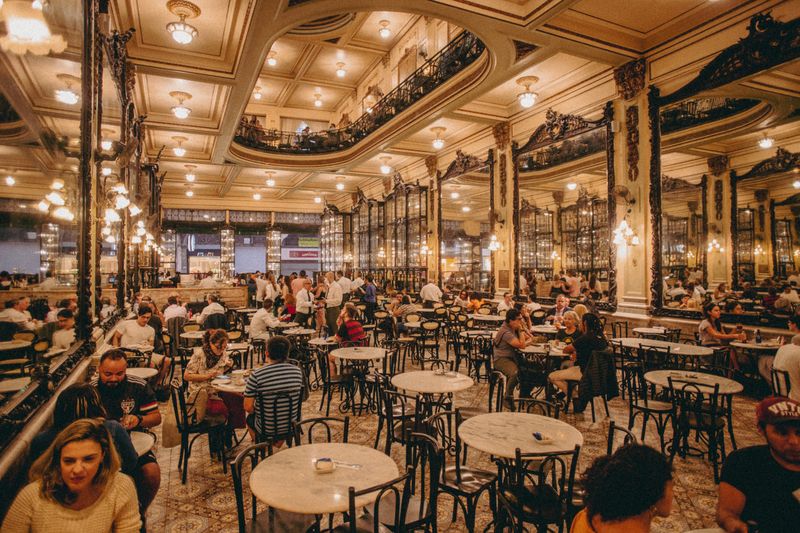
A pastelaria is built around a display counter of pastries and a coffee machine behind it. Whatever else it serves, that counter is the reason the room exists and where the margin sits.
The consequence for a visitor is timing. The counter is fullest in the morning and again in the late afternoon, and thins out at the hours when people are eating meals elsewhere.
Seating in a pastelaria is usually secondary and sometimes almost incidental. A few tables exist, but the room is designed for people who will be gone in ten minutes.
Cervejaria and casa de pasto point at a kitchen
A cervejaria grew out of beer service and the shellfish and snacks that sold alongside it. The kitchen is real, the hours run late, and coffee is something served at the end of a meal.
A casa de pasto is the plainer end of the same idea: cooked food at a fixed daily rhythm, aimed at people eating lunch rather than lingering. The name signals price as much as menu.
In both, arriving at three in the afternoon for a coffee is possible but slightly beside the point. The room is organised around its meal service and quietens sharply between sittings.
Snack-bar is the flexible category
Snack-bar is the broadest of the terms, covering rooms that serve coffee, sandwiches, beer and a simple hot plate across a long day without committing to any one of them.
That flexibility is the value. A snack-bar is the room most likely to be open at an awkward hour, because it has not organised itself around a single service.
It also explains why the category is the most variable in quality. With no defining product, the standard depends entirely on who is running it.
Old signage outlives the business behind it
Some fascias are protected or simply expensive to replace, so the word above the door can describe what the room was rather than what it now does.
The reliable check is the interior: where the counter sits, whether there is a pastry display, whether tables are laid for a meal. The layout is harder to fake than the sign.
Reading both together is the useful skill. The sign gives you the category the room was built as, and the fittings tell you how far it has since drifted.
Questions readers ask
Does robusta give a stronger caffeine hit?
Per gram, yes, roughly double. Whether you notice it depends far more on how much coffee is in the cup and how many cups you have had.
Is there a third species?
Several exist commercially at small scale, including liberica and excelsa, mostly in Southeast Asia. They are rare outside their growing regions.
Also by Helena Sá
- Alfama, Graça and the difference two streets makeNeighbourhoods
- Roast level is a decision about acidity, not about strengthCafés & Coffee
- Why the same beans taste different in two cafesCafés & Coffee
- Portuguese espresso is not a smaller Italian oneCafés & Coffee