Day Trips
Sintra is wet because of where the hill stands
The mist, the moss and the strange palaces are all consequences of one piece of geography. Understanding it explains what to wear and when to go.

These are listed in the order worth acting on, which with sintra weather is not the order they are usually presented in.
What matters most
- A granite ridge close to the Atlantic forces moist air upward.
- That produces cloud, mist and far more rain than the city nearby.
- The cool damp microclimate is why the gardens grow what they grow.
The mechanism
A steep ridge rises abruptly a short distance from the Atlantic, directly in the path of the prevailing westerly wind off the ocean. Moist sea air forced up that slope cools as it rises, and the water vapour it carries condenses into cloud and mist.
The result is a hill that generates its own weather, frequently wrapped in cloud while the coast a few kilometres away is clear. This is orographic lift, the same process that makes any coastal range wetter than the plain behind it, operating at small scale. It is why the same day can be hot and bright in the city and cold, grey and dripping on the ridge.
What that does to the vegetation
Constant moisture and mild temperatures support dense woodland, ferns, mosses and tree species that would struggle a short distance inland. Nineteenth-century landowners exploited this deliberately, planting collections from other wet temperate regions that thrived here and nowhere else nearby. The result is a landscape that looks transplanted, because in a botanical sense a great deal of it was.
Paths are frequently slick with moss and wet leaf litter even when it has not rained recently, which is a genuine hazard. The gardens are the real attraction of the place, and they are a direct product of the climate rather than of taste alone.
Why the palaces are there
The hill was cool in summer when the city was hot, which made it the obvious retreat for anyone who could afford to leave. Elevation, views over the coastal plain and defensibility gave the site value long before it became a leisure destination.
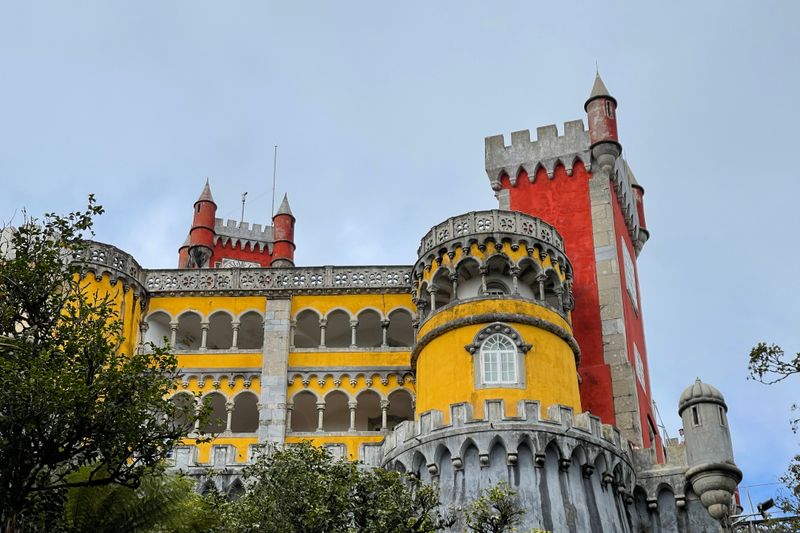
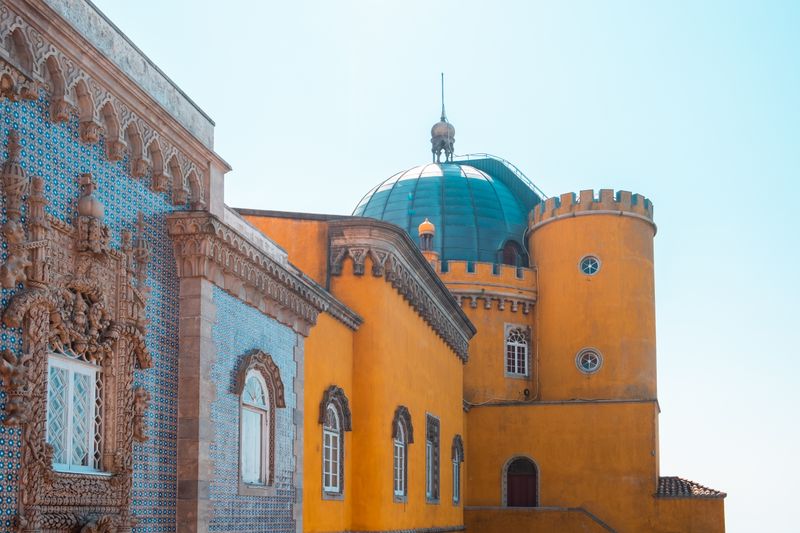
Romantic-era taste then valued exactly the qualities the hill supplies: mist, ruins, dense woodland and dramatic outcrops. That taste produced a concentration of eccentric architecture that would not have been built on a dry, exposed hilltop. So the buildings people come for are downstream of the weather people complain about.
Dressing for it
Take a layer more than the city temperature suggests, because the temperature difference on a cloudy day is substantial. Waterproofs are more useful than umbrellas, since the moisture often arrives as drifting mist rather than as falling rain.
Footwear with grip matters more here than anywhere else in the region, because of wet stone, moss and steep garden paths. Sun on the coast below is not evidence of sun on the ridge, and the two can be entirely different days. Carrying a small bag that can get wet is more practical than trying to keep everything dry.
Timing
Mornings are frequently cloudier as overnight moisture burns off slowly, and afternoons can clear unexpectedly. The clearest conditions often come with an easterly wind, which stops the ocean air being pushed up the slope at all. Summer brings both the largest crowds and the most reliable weather, which is an unavoidable trade-off.
Late autumn and winter give the atmospheric version of the place, with far fewer people and a genuine chance of being rained on all day. A day with fog is not a wasted day here, because the fog is part of what makes the landscape what it is.
If that does not fit your week, it is not a failure of willpower.
The crowd problem is geographic too
The main sites sit on a narrow ridge reached by winding roads with very little parking and limited road width. That geometry, rather than raw visitor numbers, is what produces the congestion the place is known for.
Arriving by train and walking or using local transport up the hill sidesteps most of the road problem entirely. Walking up through the woodland is steep but is genuinely pleasant and removes the queueing from the equation. Treating the hill as a walking destination rather than a driving one changes the day completely.
Everything above, in order of what to do first
- The mechanism. A steep ridge rises abruptly a short distance from the Atlantic, directly in the path of the prevailing westerly wind off the ocean.
- What that does to the vegetation. Constant moisture and mild temperatures support dense woodland, ferns, mosses and tree species that would struggle a short distance inland.
- Why the palaces are there. The hill was cool in summer when the city was hot, which made it the obvious retreat for anyone who could afford to leave.
- Dressing for it. Take a layer more than the city temperature suggests, because the temperature difference on a cloudy day is substantial.
- Timing. Mornings are frequently cloudier as overnight moisture burns off slowly, and afternoons can clear unexpectedly.
- The crowd problem is geographic too. The main sites sit on a narrow ridge reached by winding roads with very little parking and limited road width.
The takeaway
The weather is not bad luck. It is the reason the place looks like that.
Small and repeatable beats ambitious and abandoned, almost every time.
Questions readers ask
Why is it so much colder than the city?
A ridge near the ocean forces moist air upward, which cools and condenses. The hill makes its own cloud, often while the coast is clear.
Should I still go if the forecast is bad?
The gardens and woodland are arguably better in mist. Take waterproofs and shoes with grip and it is a good day rather than a ruined one.